December 03, 2014

The Barr Brothers - Sleeping Operator

The Barr Brothers
Sleeping Operator
Secret City Records

There's something intrinsically delicate and considered about Sleeping Operator
– an album, that once you're invited in, is riddled with surprise, panache and a musical persuasion that's all too much to resist.

Indeed, from the ethereal opening instrumental of the rather clumsily entitled 'Static Orphans,' which then segues into (what perhaps ought to have been the opener) 'Love Ain't Enough,' one's immediately aware that The Barr Brothers are a band of abundant, yet acute, intelligent dexterity.

Having initially been formed in Boston by Andrew and Brad Barr, the band now reside in Montreal; and going by these here thirteen tracks, fall somewhere betwixt the fine finesse of The Fleet Foxes ('Wolves,' 'Little Lover' and the rather lovely 'Please Let Me Let It Go'), the much sought after, quintessential lightness of touch care of Neil Young ('Come In Water,' 'How The Heroine Dies') as well as the deft, seemingly swamp drenched guitarchitecture of Ry Cooder ('Half Crazy').

So all told, a cracking album in more ways that one.

The prime reason for this is because Sleeping Operator consists of an altogether, in vogue, varied selection songs; more than capable of tugging at a menagerie of mood-swings and the all too flippant generation that throws a hero up the pop chart.


David Marx 

July 17, 2014

Arcelia - Wrap Your Bones


Wrap Your Bones
Arcelia


When the word Arcelia is translated from Spanish into English, it means treasure chest; although the band of the same name's debut album Wrap Your Bones is perhaps best described as a quasi-modernist, acoustic collection of thirteen love songs – all of which eventually worm their way into the sub-conscious filing cabinets of your mind.

While the lush and ethereal acoustic guitar(s) of prime writer Gavin Alexander does its utmost to procure the listener, it is nevertheless the combination of all three members - Teresa Gallagher on vocals/percussion and continuing Flying Picket (forgive them Lord for they know not...) Simon Foster on vocals/cajon - that truly bequeaths those with an ear, as well as a penchant for subtlety, with the full picture.

Whether it's the folk induced, Prefab Sproutesque melody of 'Cupid' (not to be confused with Sam Cooke's song of the same name) or the suave, shimmering soul of 'Blossom;' created herein is a musical journey that's as much worth investigating as it is dripping with potential.


David Marx  

July 09, 2014

The Cambodia Space Project - Whiskey Cambodia


Whiskey Cambodia
The Cambodian Space Project
Metal Postcard Records

Whisky Cambodia, the third album by top Khmer beat-combo, The Cambodian Space Project, really is a rather fab and at times, intoxicating album. Its ten tracks instinctively fall somewhere betwixt the heady rush of what initially made Detroit great to begin with, and a musical trajectory of a certain sweltering, sixties induced, Cambodian twist-a-thon.

Think I'm kidding? Think again, for as as recently quoted in The Guardian, this lot are: ''a rousing, quirky reminder of the pre-Khmer Rouge golden era of Cambodian pop.''

Not that I'm a connoisseur of said era, but I do know a quintessentially ice-cool groove when I hear one. And if this album's opener 'Dance Twist' isn't of the sweatiest, quasi Northern Soul persuasion - one of the finest I've heard in a very time long in fact - then I really don't know what is.

Worth hearing just for the very incisive Booker T'esque guitar alone...

David Marxx

March 24, 2014

Faye Rogers - Thunder


Thunder
Faye Rogers
Secret Chord Records

To call 'fate a fraud,' understandably takes some doing - especially when those doing the calling would no doubt want to be believed.  But when the erstwhile is delivered by way of such idiosyncratic, musical innocence that simply saturates this four-track EP, one indelibly knows one's on to a potentially good thing.

To be sure, this debut release by Swindon songstress, Faye Rogers, comes replete with more perspicacious promise than most.  'Beautiful Lies' for instance - wherein Rogers does indeed suggest that ''fate'' is nothing other than ''a fraud'' - hangs on the musically canonesque coat-tails of a keyboard line, that, although a tad too linear for it's own good, still manages to (somehow) home in on the listener. 

And like most of the material throughout Thunder, it's as if one is inadvertently overhearing a conversation in a crowded bus or tube train; wherein what's actually being said is as silently pronounced as a troubled after thought. As such, there's something coquettishly touching to be gleaned. 

Whether it's such weighted turns of phrase as ''All the fantasies I pinned on you'' ('Thunder'), or ''I want to own the blueprint of your soul'' ('Gathering Dust'), or the simple, delicate dexterity of her delivery; Faye Rogers most definitely warrants keeping an eye on. 

Even if only to hear her (one day) write songs, that clock in at under three minutes.

David Marx  

March 09, 2014

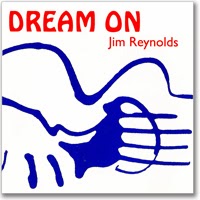
Jim Reynolds - Dream On

Dream On
Jim Reynolds
Runner Records

Comfortably nestled somewhere betwixt the (former) foregone conclusion of yer blues incorporated era Eric Clapton meets Andy Fairweatherlow were he to have dabbled in ragtime, Jim Reynolds is an exceedingly well versed bluesmith from Bristol. 
 
By way of his ten fingers, he has a particular penchant for musically transporting the listener unto another place, which, although perhaps a little too derivative for its own good, most certainly makes for a mighty resfreshing change from that of the current tsunami of all too considered teenage angst.  That horribly wishy-washy genre of pained fourteen year-olds with acoustic guitars, who, by way of limp-wristed, acute irritating bollocks - for that is what it invaraibly is - profess to be in more pain than a menagerie of grief stricken, Syrian mothers. 
 
Alas, forgive them Lord, for they not what they inexorably whine about.

So yeah, eventhough this fifteen track CD Dream On was released a number of years ago, it still shines on like a long lost diamond that's suddenly been found. 
 
To be sure, there's a deeply entrenched honesty about the whole affair, which, apart from being highly commendable, is a commodity that is sorely missing amid so much of today's saccharine induced, sordid wank.  This is partially substantiated by the fact that five of the tracks were recorded live at the Albert Inn in Bristol, while the remainder were recorded in the studio.  
 
In and of itself, I found this to be a rather daring, musical undertaking, even if only from that of the perspective of production.  Although to be honest, the songs are just as sonically reflective as they are complimentary with regards subject matter.  That eleven of them were written by Reynolds, makes for a refreshing change, especially given the current potential for tired stasis within the parameters of blues (as a whole).  And even if three of the album's stand-out tracks weren't written by him (Nick Drake's 'Northern Sky,' Jimmie Rodgers '99 Blues' and Chuck Berry's '30 Days'), most of the songs throughout are of an inspired, joyous persuasion.
 
'Feelin' Too Good Today Blues' and 'Thinking About You' are particulary strong originals; the former of which is nicely aided and abetted by way of Dave Griffiths' mandolin and Gina Griffin's violin (towards the end), while the latter leaps forth by way of a resoundingly provocative/melodic departure.  The musicality of which, I personally believe Dream On  could have done a whole lot more with. 
 
That said, Jim Reynolds has herein delivered a fine and rather wonderful album that warrants a cascade of listens and a tumultuous round of recognition.

David Marx

January 12, 2014

The Automaniacs - Open All Night

Open All Night
The Automaniacs

Other than the fact that I'd be mighty curious to hear what some of these musical pieces might actually sound like with vocals, the seven original tracks on this debut album by The Automaniacs, really is a feisty and somewhat invigorating musical challenge of the first degree.

I say feisty, because Open All Night appears to have disposed of most recognised parameters within the prog-rock genre - which I guess it essentially is - by way of chief Automaniac, Shaun Barry, having taken it upon himself to occasionally let rip whilst simultaneously pushing the all too staid boundaries.  

Hence the final result being both idiosyncratic and invigorating.

To be sure, Messrs. Barry (guitars, bass, keyboards and voices) and drummer Jef Browning, have herein assembled a menagerie of musical moods, soundscapes and guitarchitecture that not only kneels at the alter of ye fantabulous Pink Floyd circa Relics - opening and closing tracks 'Ocean/Daddy, It Feels Like There's Stones In My Gums' and 'John Slips Inside Jill, But It's Not Her He's Thinking Of' in particular - but also nods a surprisingly winsome wink towards a number of other seventies space meisters.

To be sure, The Automaniancs vision is a considered analysis of a pop induced sensibility drenched in former Gong and Hawkwind day-trips.  That's not to say these day-trippers only work and record within the elongated trajectory of the seventies, as the Radioheadesque 'Heart In Hand, Head In The Clouds' wholly substantiates. 

As for fans of Hank Marvin (that's right folks, you read correctly), a Shadows toon cum riff rears its all too renowned head around the 7:15 mark of 'Teapot Dream;' but this ought hardly be surprising considering the altogether, exceedingly clean Strat sound throughout the album as a whole. 


And in and of itself, this will undoubtedly inspire all disciples of Marvin and Gilmore as in Hank and Dave - thus accounting for Open All Night simply oozing with resolute panache and potential.

David Marx

October 24, 2013

RoseAnn Fino

RoseAnn Fino
RoseAnn Fino
 Woodstock Records

If nothing else, this debut album by RoseAnn Fino, simply sparkles with elongated, musical promise and potential. Each of its twelve tracks (the twelfth, 'Sink Your World,' being a bonus track) has that certain something, that can only be described as quintessentially alluring.

To be sure, the American songstress - from New York's Hudson Valley - has honed her craft to such an idiosyncratically attractive degree, as to be augmented by Professor Louie & The Crowmatix and occasional Van Morrison guitarist, John Platania. This can only be described as a good thing, especially on such a lush and ethereal number as the opener 'Change My Mind,' and the more than musically expectant 'Seventies Trousers' (cool title). I say musically expectant due to the song's inviting, descending chord structure.

Replete with an album cover that really does tick all the boxes; the essential one being that you're immediately drawn to it - so well done Messrs. Spinosa, Rosenbaum and Greer - some of the songs fall within the tell it as it is parameters of such soul-drenched country artists as Iris Dement and Lucinda Williams. Reason being, snatches of Fino's phrasing on 'You and I' is reminiscent of the former, while the subject matter of 'My Good Friends' evokes that of a younger version of the latter.

While Producer, Aaron L. Hurwitz, really has done an intrinsically commendable job, I'd personally recommend that many, if not most of the songs, would greatly benefit from being a lot shorter. This may partially explain why 'Little Girl Lost' and 'My Good Friends' (at 1:51 and 3:30 respectively) are the two strongest songs on the album. As a result of these two being more succinct, they're more believable.

Other than the length of the material, I also feel inclined to say that RoseAnn Fino is, at this stage at least, a better writer than she is a singer. BUT, this will probably change; especially if she continues to sit ''in the kitchen drinking boxed wine,'' and continues to listen to ''Bob Dylan singing 'I shall be free''' ('Boxed Wine').

David Marx
www.davidmarx.co.uk

October 17, 2013

Luka Bloom - This New Morning


Luka Bloom
This New Morning
BigSky Records

As socially idealistic and summery as this most recent release from the Irish singer/songwriter Luka Bloom is, it still resonates with a certain panache and honesty.  A facet that ought hardly be surprising, especially considering Bloom is the younger brother of Christy Moore. 

To be sure, the thirteen songs on This New Morning do much to promote and pronounce something of a feelgood factor, even though the album's opener 'How Am I To Be?' can only be deduced as being a very brave track with which to open.  This is all the more substantiated by the fact that the first four lines are fundamentally sung accapella (with just a hint of background guitar):  ''How am I to be/When so much is new?/So much feels broken/And falling through.''

Having musically set the tone of the album forthwith, Bloom decides to deflect issues by another relatively proud piece, 'A Seed Was Sown.'  I use the word proud with caution here, as it all depends on where one stands in relation to the monarchy (yes, that right folks, an Irishman singing of today's Royalty!).  In the sleeve notes - before one reaches the actual lyrics - Bloom writes:  ''May 2011, for the first time in 100 years, a British monarch visited Irish soil. Queen Elizabeth stood in the Garden of Remembrance in Dublin at the side of President Mary McAleese, and bowed before a monument remembering fallen Irish heroes.'' 

The actual song itself might not be as melodic as the opener, but the sentiment on the second bridge in particular, more than makes up for this:  ''I've been holding on/To hurts from long ago/I've been holding on/Like its all I really know/A seed was sown.'' 

I'm not really sure why, but I do feel compelled to say that This New Morning really couldn't have been recorded by anyone other than an Irishman.  Apart form the accent, it's also the sentiment(s) at play, which substantiates my thinking.  And this is especially true in the case of such tracks as the oddly titled 'Heart Man' (dedicated to a friend by the name of Shane O'Neill), the ethereal 'Capture A Dream,' and perhaps one of the more powerful songs on the album, 'You Survive.' 

Having been asked to ''write a song about surviving suicide,'' Bloom most certainly and defiantly delivers with the most utmost of poignant declarations.  For on the penultimate chorus of 'You Survive,' he tenderly declares: ''You survived/You survived/You're here another day/Of precious life.''
If nothing else, this is probably one of the most heartfelt albums I've heard so far this year, and as usual, I look forward to his next work(s).

David Marx

www.davidmarx.co.uk

October 03, 2010

Joshua Ketchmark - List of Regrets


Joshua Ketchmark
List Of Regrets
Self Release

This eleven-track album by Joshua Ketchmark, is a full on, roller-coaster ride through the back pages of downtown potential and West Coast Americana. In other words, List Of Regrets is a high-octane, smorgasbord cross betwixt mid-nineties Matthew Sweet (circa Girlfriend) Ryan Adams (circa 29) and the mighty under-rated Dramarama (circa Hi-Fi Sci-Fi).

So, lots to ponder and riddle upon.

The slow build of the blues based opening track ‘How 2 Let Go’ (replete with Prince spelling), compellingly sets the stage for what’s in store. Its kloof like musicality, wholeheartedly lending itself to the rather lyrically pensive follow-up, ‘Never Beautiful.’ A song that’s as equally introspective as it idiosyncratic, one would indeed be wise to traipse with considered caution, especially when Ketchmark sings: ‘’I can see you scatter/Breathing misconception/Into all of your answers.’’

Gadamer with a guitar (German philosopher, who, by way of Truth and Method, tried to clarify the phenomenon of understanding)? Or, inadvertent sage with a mighty list of pronouncements to make, by way of rock’n’roll?

Either way, what we have here and throughout the album as a whole, is a compelling assortment of niftily crafted toones; replete with well-constructed words and measured production by Ketchmark himself. Prime examples being the backwards Beatlesesque guitar on ‘On Your Shoulder’ and the distorted avalanche of guitars (care of Greg Ripes) throughout the alluringly titled ‘Maybe.’

To be sure, when the singer/songwriter moves away from the more obviously clinical rock stuff, the embryonic intensity of drama in such a song as ‘It Doesn’t Mean The Same’ is invariably allowed to breath and shine. A line such as ‘Spanning time between cigarettes and rosaries/And claiming that it’s/The only way,’’ might, in some quarters, be considered as good as it gets. But, because it’s partially and unfortunately smothered with superfluous clutter, it doesn’t quite hit the mark. This is a shame really, because as mentioned at the outset, List Of Regrets has oodles of potential.

The sort of which, warrants both recognition and respect.

David Marx
www.davidmarx.co.uk
www.myspace.com/davidmarx

September 22, 2010

Grinderman - Grinderman 2


Grinderman
Grinderman 2
Mute

A tough onslaught of bonkers and irresistible mayhem, this second Grinderman album is not only a swaggering statement of malevolent menace, it’s all things one has come to expect from Nick Cave and assorted Bad Seeds - plus a whole lot more besides. Indeed, hornier than an Italian erection convention, most of the songs on this nine-track CD, cum replete with counter-insurgency wordplay, skewered, shredded (backwards) guitars, a kick in the bollocks rhythm section and an overtly defiant, psychedelic, post-apocalyptic cabaret persuasion.

As one may recall, the original Grinderman manifesto was: ‘’no God, no love and no piano,’ which, depending on one’s own schismatic shaboogie, the blues/punk infused foursome fully adhered to on their debut.

But Grinderman 2 is a different animal altogether - with the emphasis on animal.

There may well be something of the continued deconstruction of Cave’s masculinity throughout, although his ravenous, lizard-brain persona is herein, far more agonistic. For instance, the gnawing guitars and persistent bass drum’n’tambourine on current single ‘Heathen Child,’ are expressively beast-driven, not to mention a little sympathetic to that of a Lennonesque inflection; especially when the lyrically ebullient Cave sings: ‘’I don’t care about Buddha/Care about Krishna/Don’t care about Allah.’’ Admittedly, some may consider the song’s construction as a simple re-working of ‘No Pussy Blues,’ but once one has taken the head-rush of imagery on board, this comparison with the latter’s tongue-in-cheek sensibility will probably fall by the wayside.

That said, it’s the musical foreboding of the album’s two opening cuts ‘Mickey Mouse and The Goodbye Man’ and ‘Worm Tamer’ that truly invigorate.

The fairytale perversion of the former, finds Cave and his three bad Seeds as bad as bad can be - wherein idiosyncratic intelligence looms and smacks its way out of any pre-ordained (trusted) parameters. Ace intermittent drums amid an equally ace, inexorable bass-riff, reveal the true grit of Grinderman’s propensity for full-throttle mayhem in the extreme. And what a fucking great, perpendicular porn like noise it is too. One can’t help but feel swept up within it’s contagious and nigh hypnotic current; for such is the velocity of the song’s initiation and invitation. Likewise, the grinding Perspex emancipation of ‘Worm Tamer,’ itself a wizened whirlpool of extraordinary sound - within which Cave magnificently reveals: ‘’My baby calls me the Loch Ness Monster/Two great humps and then I’m gone.’’

Talk about swiftly severing the warped tentacles of rock’s elongated, pregnant paralysis.

However, if it’s a great couplet you’re after, you won’t find anything more immediately enticing than: ‘’The spinal column of JFK/Wrapped in Marilyn Monroe’s negligee’’ on one of the album’s strongest pieces of work, ‘Palaces Of Montezuma.’ A tad reminiscent of The Rolling Stones’ ‘Sympathy For The Devil’ (which ain’t necessarily a bad thing) said song is thus annoyingly hummable and simply littered with such great lines as: ‘The custard coloured super dream of Ali McGraw and Steve McQueen.’’

The lyrical flip side of the above is the sparse and sinister ‘When My Baby Comes,’ in which it sounds as if Cave sings from the standpoint of a rape victim. Just like the quietest song on the band’s debut album ‘Man In The Moon,’ this too is the most severe (in terms of sexual/social analysis and provocation). It succinctly states its case before moving on.

While ‘Evil’ is akin to intelligent Motorhead and ‘Kitchenette’ is psychedelically reminiscent of nineties New Jersey outfit The Iconoplastics, the album’s closing track ‘Bellringer Blues,’ is, like many of the singer’s closing tracks, an exercise in Cave by numbers.

Other than that, Grinderman 2 is as much a divine racket as it is essential listening.

Majestically produced by Nick Launay and the band themselves, one cannot help but wonder what the next Grinderman release will entail (not to mention the effect and influence these albums will have on future Nick Cave and The Bad Seeds recordings). Great stuff.

David Marx
www.davidmarx.co.uk
www.myspace.com/davidmarx


September 10, 2010

The Overdue EP


Peregrine
The Overdue EP
Private Practice

Effervescent and ethereal, cerebral and conclusive, Peregrine are of the quintessential singer/songwriter persuasion - as in songs with considered words; which, when aligned with a certain delicacy of touch, makes for more than compelling listening. Something, which in this day and uber age of petulant pout saturation, is mighty refreshing to say the least.

Along with the likes of David Gray and perhaps early Elvis Costello circa ‘Allison,’ this five-piece Australian outfit from Sydney (although drummer Mat Smith is from Liverpool) are as equally deft at listening to one another as they are conveying the musical vision of singer and chief Peregrinian, Brett Winterford.

Having recently seen the band perform six songs at Berlin’s Jägerklause, The Overdue EP, while reasonably well recorded (mastered at Abbey Road no less!), doesn’t quite hit the mark of experiencing the band live. To be honest, this is hardly surprising, for with the (possible) exception of Bruce Springsteen, ninety-nine per cent of recording artists fall short of hitting the mark and reproducing their onstage live performance. Which in and of itself, explains why the likes of Robbie Williams and Madonna - unlike this lot - feel the need to employ several hundred (nigh) naked and superfluous dancers, several snakes and tanks, whippets, murderers, paraplegics and perverts, simply because they’re so fucking dull, vacuous, insincere and awful live. But I digress…

The EP’s opener ‘Curious’(the band's current single) is a lovely song, sung with all the illustrious persistence of someone who essentially knows what he’s talking about. The same might be said for the follow-up and perhaps strongest song on the EP, ‘The Usual Thing.’ But having watched the band perform both songs live, I have to confess they were a tad more beguiling, if not conversational in execution amid said setting.

The epic ‘Love Lost’ is something of a musical drama (replete with Gilmouresque guitar care of Felix Akurangi), the soul drenched ‘Sunshine’ truly benefits from its inclusion of what sounds like a Hammond organ, while ‘Overdue’ bequeaths the listener with a much warranted confidence and profound sense of tumultuous, groovy things to come.

David Marx
www.davidmarx.co.uk
www.myspace.com/davidmarx

August 26, 2010

Richard Hawley - False Lights


Richard Hawley

False Lights From The Land

Mute

Inspired by the sea and all things nautical, False Lights from the Land is (perhaps) something of a stopgap release by Richard Hawley that finds him casting an ever increasingly wider net unto quintessentially familiar waters. For while the Sheffieldonian may be looking to bolster his audience as a direct result of his recent BBC Radio 2 series, ‘The Ocean,’ these four-tracks, while randomly eloquent, really are nothing new.

Released on 10” Vinyl or as a Download through Mute, said EP arrives replete with all the usual Hawley hallmarks of sparkling production, wondrous song construction and shimmering guitars - but very little else.

The elongated opener ‘Remorse Code’ from his last album Truelove’s Gutter - which clocks in at just under ten minutes - is indeed a rich tapestry of textured beauty and tranquillity. All resolute and brave and reverb drenched with a plethora of tracked, Gretsch guitars, it’s a song, which bestows an entire new meaning upon the oft used, yet little understood phrase: less is more - surely another Hawley hallmark. And although reminiscent of the classic Fleetwood Mac track ‘Albatross’ (only without the melody), it’s a song that adamantly refuses to linger.

Unlike the EP’s only other original ‘There’s a Storm a Comin,’ which simply reeks with that of a melodious persuasion.

To be sure, when Hawley stumbles upon something good, one instinctively gets the feeling he knows about it. As such, this early sixties sounding, existentialist tale of romantic woe - during which the singer comes clean with: ‘’There’s a heart a breakin’/I think it’s mine’’ - convincingly steals the show.

In so doing, it takes the wind out of the sails of the remaining two covers, ‘Shallow Brown’ (a rather staid and repetitious a cappella rendition of the West Indian original) and the Hughie Jones original (yep, he of The Spinners) ‘The Ellan Vannin Tragedy.’

A pleasant nuff reminder of a talented artist, floundering betwixt albums.

Crowded House - Intriguer


Crowded House
Intriguer
Mercury Records

Interspersed with tiny kernels of sparkling potential, Intriguer is nothing other than an album of (really) strong B-sides; which, given the majestic calibre of some of Crowded House’s previous work, is both surprising and disappointing.

Their sixth album in a career that has spanned the best part of twenty-five years - and the second since reforming, following the suicide of original drummer Paul Hester - these ten songs, although bristling with ambition, merely meander amid the slipstream of cloying comfort.

In other words, what we have here is song-writing by numbers.

All correct and relatively inventive boxes are fundamentally ticked: considered arrangements, lush harmonies, impeccable musicianship etc; but the end is result is yawningly average. There’s no real anguish, no turmoil and (perhaps a little disconcerting so far as one of this band’s major strong points is concerned) no real melody! Admittedly, the likes of the McCartney induced ’Falling Dove’ and ’Even If’ might be the exception to the rule; yet even here, said songs fall amazingly short of the mark.

No where on this album is there anything that comes remotely close to the brilliance of ’Fall At Your Feet’ or ’Four Seasons In One Day.’ And while ‘Amsterdam’ did indeed sound rather wonderful when the band recently performed it live on Radio 2, herein, it sounds horribly flat and bereft of either intensity or drama. Like much of this album, it just is, which, as hinted at the outset, for a band of Crowded House’s stature, isn’t the norm and isn’t good.

In truth, Intriguer ought to have been terrific as it certainly has the potential. Such idiosyncratic tracks as ’Isolation’ and ’Elephants’ depict a certain urgency, sorely lacking throughout. But where the former evolves into ghastly heavy metal mush by way of an endless guitar solo, the latter is unfortunately lacking something. Perhaps gravitas. Perhaps truth.

Perhaps both.

Avid fans will probably love it.


August 25, 2010

Rip It Up


Rip It Up
Rip It Up
Ankh Music

These eleven, rather eclectic songs, are, if nothing else, a curious concoction of whiz-bang potential amid a slipstream of rock’n’punk’n’surf drenched familiarity. A musical ménage a trios if you’ll pardon the expression (but not necessarily the image), that bequeaths the listener with an abundance of cerebral induced sounds, many of which trigger many a moment.

Formed in the summer of 2006 and named after the classic Orange Juice hit of the eighties, Rip It Up’s same named debut introduces itself by way of a deft, delicate and somewhat surprising rendition of Jimi Hendrix’s ‘Angel.’ Going by the song’s opening guitar riff, one instinctively knows one’s in for a perpetual roller-coaster ride through the back pages of Messrs. Al Gregg and Rashid Ali’s (s)punk, drunk celebration, which in and of itself, snuff to procure many a wondrous musical waif in waiting. That said rendition consists solely of voice and guitar - neither of which outstay their respective welcome(s) for a moment - plays testament to the duo’s divine dogma of propulsive brevity.

The uber distortion of Penetration’s ‘Call It A Day’ and the title track itself, admittedly reveal closet limitation and something of a rogue like quality, although the drum-machine aesthetics throughout both, do much to inject the album with that of a (much sought after) spit’n’wit naivety. And depending on yer viewpoint, such drama can occasionally teeter upon the precipice of petulance and innocence: simultaneously. Yesireeeeeeeeeeee, this is more than substantiated by the eventual swathes of Gregg’s intuitively, distorted guitars.

While ‘Trash’ is reminiscent of a Prince out-take and the cod-reggae of ‘I Think You Ought To Know’ (replete with guitar harmonics) isn’t exactly a hundred miles removed from that of third division noo-wavers, The Members - who, for some reason or another, are still strutting their stuff - the strongest and most cohesive track on display has to be ‘Out Of Control.’

Once again, it does that teetering thing - which, if truth be qualified, is the one thing that’ll irrevocably set Rip It Up apart from the several hundred thousand other albums upon release this week.
http://www.reverbnation.com/thebandripitup

June 03, 2010

Propellor Time


Robyn Hitchcock & The Venus 3
Propellor Time
Sartorial Records

Psychedelic minstrel and all round groove merchant of both impeccable taste and chiliastic calibre, Robyn Hitchcock (who else?), returns with Propellor Time, his third Venus 3 album since 2006 - Venus 3 being the three-piece outfit with which the Hitch has surrounded himself of late.

And jolly fab, if not a tad idiosyncratic they are too.

This ought hardly be surprising, considering they are made up of former Ministry drummer Bill Rieflin, Young Fresh Fellow, Scott McCaughey on bass, and the irrepressible REM guitarist, Peter Buck, on assorted jingle-jangle sparkle. So as Venus 3, said three contribute to Hitchcock’s quasi-existentialist musicality in such a way that it sounds as if they’ve been together for at least thirty-five years.

The mercurial opener ‘Star of Venus,’ being a perfect example of the exquisite understanding conveyed throughout. With a relaxed, cerebral feel that so many of today’s young bucks would clearly fail to muster in a hundred million elongated life-times (with the possible exception of The Arctic Monkeys), the interaction betwixt the four is both wry and wondrous to behold. Replete with Hitchcock’s quirky and eccentric Englishness - which is admittedly not too far removed from Syd Barrett era Pink Floyd - it is immediately apparent that this, along with ‘The Afterlight’ that follows, is not the sort of song you’re ever likely to hear on the Ken Bruce Show.

To a certain degree, this might be considered a good thing - although from a shifting product perspective, perhaps not quite as inspiring to the man in question as that of the dreadful Leona Lewis.

Still, as Tony Soprano likes to say, ‘waddaya gonna do?’
Bequeath the world with turgid repetition or continue to traipse the boards of individuality?

That the kindred and utopian spirit Nick Lowe lends a hand - on what can only be considered the most lush of harmonies on three tracks - is an added bonus; as is the appearance of former Zep multi-instrumentalist, John Paul Jones, on mandolin.

While the latter’s contribution is on a live rendition of ‘Luckiness’ as well as the album’s closing track ‘Evolove,’Propellor Time’s stand-out track has to be ‘Ordinary Millionaire.’ Co-written with former Smiths guitarslinger, Johnny Marr, the song’s introduction arrives by way of Kate St. John’s austere and rather glorious cor anglais, before kicking in with the coolest of chord structures; eventually evolving into one of the most eloquent of (original) songs heard in a long time.

Moreover, it’s the trajectory of Robyn Hitchcock’s mid-period Revolver influence of The Beatles, along with the aforementioned Piper At The Gates of Dawn era Pink Floyd, which continues to align (t)his work with (occasional) brilliance, substance and coherence. Regardless of guest musicians.

For this reason alone, is the former Soft Boy’s work always worth investigated and delving into, even if only to momentarily remind oneself that music still actually counts for something - other than disgusting tax returns and deplorable, vacuous ratings.


David Marx
www.davidmarx.co.uk
www.myspace.co/davidmarx


May 25, 2010

Nathalie Merchant -Leave Your Sleep


Natalie Merchant
Leave Your Sleep
Nonsuch


Six years in the making, this most recent album by former 10,000 Maniacs utopian upstart, Natalie Merchant, really is quite something. A double-album of exquisite musicality and brazen poetic interpretation, Leave Your Sleep consists of 25 songs, all of which in some form or another are unique in arrangement and composition.

As such, it ought to come as no surprise that there are the best part of a hundred musicians at play here (among them: Wynton Marsalis, Medeski and The Klezmatics), whose commanding authority and all round listening persuasion, is a resounding, all encompassing and infectious pleasure to behold. The dexterity and the veritable nuance of interaction employed throughout, is something one doesn’t hear anywhere near often enough.

To be honest, with the exception of those who play with Tom Waits, and perhaps assorted members of The E Street Band, such regal musical accomplishment is indeed, very, very rare. Thus making for a recording, which could quite possibly be a contender for best, if not the best album of the year.

With lyrics culled from the 19th and 20th Century canons of British and American poetry – including that of Charles Manley Hopkins, Ogden Nash, Robert Louis Stevenson, Robert Graves and Edward Lear to name but a few – these interpretations are of a distinctly mature and varied design. From the elegiac opening of Cornish poet, Charles Causley’s ‘Nursery Rhyme of Innocence and Experience,’ right through to the brave bravura of the closing track ‘Indian Names,’ one is musically chaperoned through a lush and wonderful head-rush of one sparkling genre after another (after another).

From the twirling, whirling bluegrass of ‘Calico Pie’ to the Elvis Costelloesque (circa Imperial Bedroom) ‘It Makes A Change,’ to the oriental infused pearl that is ‘The King of China’s Daughter,’ these songs are nothing other than a tantalising traipse through the elongated park of brilliance – and we haven’t even reached the second CD yet…

That the bar is raised so (refreshingly) high is, along with the ravishing beauty of many of the arrangements, to be resoundingly applauded. From intermittent sprightly folk, through to skat-jazz, southern-fried blues and Ukrainian bewilderment, Messrs. Merchant and Andres Levin (who has worked on such a similar project with David Byrne) can feel proud at having co-produced such a colourful album of alluring charm.

To be sure, a synthesis of similarity begins to take (subliminal) hold about halfway through the second CD - what with the occasional over abundance of fiddles’n’banjos’n’tongue-in-cheek recipes of far too many truffles’n’porcupines – but this is ever so resoundingly made up for by such stand-out tracks as ‘Adventures of Isabel’ and perhaps the most thought provoking track of the lot, ‘Griselda.’ The latter of which, combines the Merchant of Ophelia’s yore, with the effervescence of the here and now.

Other than being synth free (resounding applause please), Leave Your Sleepis simply drenched in flesh and blood, truth and stand-up bass, wisdom and curiosity. What more could you possibly ask for?

David Marx
www.davidmarx.co.uk
www.myspace.com/davidmarx


April 08, 2010


Martin Doherty/Leigh Birkett
Dare To Struggle, Dare To Win
BRS

Having produced and put two charity albums together myself - Green Indians (RR110658CD) and Reaction (RR080686CD), I fully understand the sheer amount of blood, sweat and toil involved. And while one can initially come away with a sense of enormous achievement and emotional cleansing, it’s not long before such quintessential feelings subside into that of hollow fulfilment and expectation.


That Dare To Struggle, Dare To Win has (clearly) been compiled with a huge amount of love, respect and dignity, is to be applauded.


Even before having been heard.


Indeed, these twenty tracks - twelve songs and eight spoken words - are the works of Martin Doherty and Leigh Birkett; and have been put together in honour of Union Leader and highly influential figure in Australian social politics, John Cummins (1948 – 2006).


Most of the material is of an organic and folk leaning persuasion, the likes of which espouse straight talking over bollocks, crystal clear morality over myopic economics. Songs such as Rita McNeill’s ‘It’s A Working Man I Am,’ Tom Paxton’s ‘They Couldn’t Take The Union (From Your Soul)’ and Ewan McColl’s ‘England’s Motorway,’ are as poignant in their regaling of hardship and petulant greed, as they are (musically) resoundingly sparse.


Moreover, while the traditional ‘The Ballad of Jim Larkin’ may be a little confusing and a tad too expansive with regards wanting to be all things to all men, it’s the succinct beauty of a track such as ‘Shearers On The Wallaby,’ that truly anchors the album amid the subject for that which it was intended.


On the former, Doherty sings: ‘’They shot McDerlott and Pearse and Plunkett,/They shot MacDonagh and Tom Clarke the brave,/From bleak Kilmainham, they took Kent’s body/To Arbour Hill and a quick lime grave./But last of all of the seven heroes,/I sing the name of James Connolly,/The voice of justice, the voice of freedom,/He gave his life that we might be free.’’ Now unless one knows ones’ Irish history, such lyrics are perhaps a little too dense and too wide off the mark to be fundamentally taken on board. Whereas ‘Shearers On The Wallaby’ finds the same singer hitting home nigh immediately with the simplistic, yet far more plausible: ‘’I’m a shearer on the drink again,/With no shoes upon my feet.’’


Judging by the spoken word excerpts scattered throughout, one gets the feeling John Cummins was a man without complication - hence one of the printed lines in the sleeve: ‘’When you find an easy way, don’t keep it a secret.’’


As such, the more candid songs on this album are the more powerful.


Either way, Dare To Struggle, Dare To Win is a sincere and powerful piece of work. It’s a recording which deserves all the attention it gets – even if only to shed light on the dictum: ‘’judge people by their form.’’


David Marx
www.davidmarx.co.uk
www.myspace.com/davidmarx


State of Undress
Livin’ It, Lovin’ It
Rosebud Music


A raggle taggle consortium of sound not a hundred miles removed from that of an over zealous Steelye Span meets B-side Waterboys, this 2009 release by State of Undress, strikes one as being a mere tip of the band’s rich musical potential. Reason being, there may be snippets of poise and promise at play here, but an underlying quality that the five-piece have overwrought themselves is, unfortunately, a tad more pronounced.


The opening track ‘One More Shot (of you boy)’ sounds as if two different bands are playing the same track; which, although on occasion do (perhaps by accident) converge, ultimately end up chasing one anther’s tale. Were it not for the underlying glue like quality of Samantha Jane’s pizzicato violin, one wouldn’t really know who or what to listen to. And while there’s a definite Steve Wickham influence at play throughout ‘Plenty More Fish in the Sea’ – worth mentioning, purely as a result of the texture and sheer amount of reverb utilised during Wickhams’s stint with ye Waterboys during their spurious Irish period, was at the time, as indicative of their sound as that of Mike Scott. Although in this instance, a rather lacklustre performance by the band as a whole, doesn’t do the song itself any favours.


It’s not until one reaches the strongest song on the album ‘Mudeford Mood’ (cool title), that things begin to quintessentially sparkle. Replete with a more considered arrangement, which, among other things, includes what sounds like looped bongos and an altogether intelligent, refreshing chord structure, it’s a song which leaves the remaining others basking in its shadow. That said, were it to have ended at two and a half minutes (rather than 4:24) it would have been even stronger.


In all, these seven songs are more akin to that of a collection of demos. Whilst showing promise, Livin It, Lovin It! doesn’t truly hit the mark of a genre that, although transiently saturated with the likes of Fairport Convention, Hothouse Flowers, Waterboys et al, remains an idiom whereby musical prowess and understanding, is still as integral as playing from the heart.


David Marx


www.davidmarx.co.uk
www.myspace.com/davidmarx


April 06, 2010

Jeff Beck - Emotion & Commotion


Jeff Beck
Emotion & Commotion
Rhino


When Jeff Beck first saw Jimi Hendrix perform live, he fleetingly considered giving up playing guitar and becoming a postman. Had he done so, it would surely have been to his own detriment and that of the music world at large. Reason being, the solipsistic gunslinger from Seattle, may well have been something of a ferocious genius in relation to detonative guitar playing, but Beck isn’t that bad of a gunslinger himself.


Having traipsed numerous boards of eclectic musicality over the years (from tear-it-up-rockabilly, to jigsaw-puzzle-jazz-fusion, to straight-laced-full-throttle rock), he who calls himself Jeff Beck, has always been very much his own man. A facet of an altogether tempestuous career, that’s as equally courageous as it is commendable as it is confabulatory. Not for nothing is he, along with the likes of perhaps Richard Thompson and Ry Cooder, so utterly revered amid the musical fraternity of past, present and future.


Triggered by the sparkling ambidexterity of Beck et al’s playing, the awe within which said musicians are fundamentally held - lies within the quintessential essence of the purity of their playing. Signed, sealed, delivered, they are indeed yours.


Replete with much sought after truth and ability.


So roll over Saul Hudson and tell all your disciples the news: Emotion & Commotion has once more, raised the guitar bar, way beyond the reach of many a great (and not so great) pretender. Within its ten tracks, are moments of sheer wonderment, wherein the former Yardbird stretches himself way beyond the usual parameters of his own musical, and, on this occasion, ethereal expectation(s).


The cinematic, charm like delicacy of the opener ‘Corpus Christi Carol’ substantiates as much, by virtue of its sheer amount of compartmentalized silence. It’s as sparse and as slight as can be. Other than Beck’s lonesome guitar and a few orchestral strings, there’s not a lot to be heard. Which, other than transporting the listener unto a precipice of mild expectation, really is quite something. Especially when one considers that this is his first album in seven years, and that prior to recording, an over-zealous Beck sliced through one of his fingers in a kitchen accident.


To be sure, seven years of inactivity would induce most artists to loom it large, nigh on immediately. But lest it be said that herein, we find ourselves listening to an artist like non other; which, depending on how hard you feel compelled to shake your moneymaker, is no mean feat (dude). As let’s be honest, could you imagine the likes of Mariah Carey keeping silent for more than a microsecond of an even tinier microsecond?


Course not. Not for all the skimpiest skirts in the western hemisphere.


‘Hammerhead’ opens by way of a rocket-charged wah-wah pedal - not exactly a hundred miles removed from that of the aforementioned Jimi Hendrix. But once the powerhouse rhythm section of Messrs. Tal Wilkenfeld (on bass) and Alessia Mattalia (on drums) kick in, said comparison comes to a complete and rather sudden conclusion. Augmented by Wilkenfeld’s distorted bass, and shot straight from the hip of Beck’s extraordinary guitar prowess, said song is utterly polar to that of the rest of the album.


With the possible exceptions of a seductive cover of the Screamin’ Jay Hawkins’ classic ‘I Put A Spell On You’ (which, albeit soulfully executed by the band, unfortunately involves Joss Stone turning in an appalling karaoke of Etta James on vocals) and an outstanding version of James Shelton’s ‘Lilac Wine’ (on which singer Imelda May displays an acute understanding of the term finesse), much of Emotion & Commotion is a nod to that of orchestral vindication and quasi-operatic sobriety.


Throughout a large part of the album, Beck is augmented by a sixty-four-piece-orchestra wherever deemed necessary. Examples being questionable renditions of such renowned pieces as ‘Over The Rainbow’ and ‘Elegy For Dunkirk.’ Questionable, as unlike his previous rendition of the equally renowned ‘A Day In The Life’ by The Beatles (which didn’t include an orchestra), here, the alignment of guitar and orchestra feels a tad superfluous if not voyeuristic. It’s all very lovely and very cathedral and very tender upon the ear, but the familiarity of the pieces themselves, are such that a resigned fortitude is more pronounced over that of Jeff Beck’s guitar.


As for the inclusion of the most celebrated section of Giacomo Puccini’s Turandot opera ‘Nessun Dorma,’ one cannot help but wonder why. Why the inclusion of such a celebrated piece of music?


‘Nessun Dorma,’ while admittedly wonderful, already means so many things to so many people. And just like life itself, memories aren’t always that great. In this instance, attached to the piece is a huge amount of subliminal and disposable baggage. Memories of the 1990 World Cup leap forth. As do memories of Britain’s Got Talent (quite possibly one of the most ghastly of British television programmes ever transmitted), which featured the rather portly Paul Potts shooting to transient fame - by way of yet another futile rendition.


All in all, it’s great to have Jeff Beck back. He’s a phenomenal guitar player - quite possibly (one of) the best in the world. One need only listen to the first two minutes of this album to ascertain as this. Were it not for a dubious selection of material, Emotion & Commotionwould be an intrinsic listen.


As is, it’s a very worthy album, but not a whole lot more - which is shame, as Jeff Beck deserves so much more.


 David Marx


Originally published by Consequence of Sound
(copyright Alexander Young)
www.davidmarx.co.uk
www.myspace.com/davidmarx


March 26, 2010


Luka Bloom
Dreams In America
BigSky Records


There’s a yearning amid much of Luka Bloom’s song writing, the sort of which is all imploring, at times alluring and acoustically intoxicating. Dreams In America is no exception to this. It’s twelve songs traverse a wide gambit of emotions, most of which essentially regale the listener with tales lost love, found love, static love and a subliminal promotion of ye quintessential trajectory: all you (indeed) need is love…


From the initial foreboding of the opening title track, to the depth-charge sense of imploring on the penultimate ‘Be Still Now’ - a philosophical ode to the here and now along the lines of ‘Let It Be’ (‘’let love come to you’’) - Bloom meanders betwixt the pathos of such heartfelt songs as ‘Bridge of Sorrow’ and ‘Ciara,’ whilst intelligently facing head-on the bathos of such drama drenched numbers as ‘Blackberry Time’ and ‘The Acoustic Motorbike.’ The melody of the former most certainly lifting the album up a gear, while the lyrical interplay of the latter (admittedly a tad Dylanesque) is surely nothing other than acute binary benediction - especially the line: ‘’An appetite that would eat the hind leg of a lamb of God.’’


Following numerous listens (even whilst doing other things) the most evident shout is that of a sense of subjective demarcation. It’s as if Luka Bloom the writer has finally met up with Barry Moore the man. He, who more than twenty years ago, left Ireland for New York, in search of the quintessential American Dream.


Hence perhaps, the title of this album.


And while it invariably remains the case that one can take the man out of Ireland, but not Ireland out of the man; so too does the same very much ring true (if not even more so) for that of New York – regardless of nationality. As I too lived in New York for a number of years, and even though I haven’t been back for quite some time, New York has never left me.


It’s as if the city has somehow seeped into, or crept beneath the pores of my unthinking soul. To be sure, an unwanted life sentence; which, for all the hesitant longing it has somehow instilled, remains a longing I wouldn’t really want to part with.


Such, it at least appears, is the underlying scenario of this collection of predominantly acoustic songs, including the additional three live tracks towards the end of the album. As having lived in Ireland for a number of years now, Luka Bloom still retains something of a Bleecker Street quality within that of his song writing - which, till death do they part, will forever remain a residue of solipsistic subject matter.


Regardless of (Irish) accent and (delicate) persuasion.


David Marx

http://www.davidmarx.co.uk/
www.myspace.com/davidmarx